

Private Investments and Crypto May Be Coming to Retirement Plans
Time to read 3 Minutes
A potentially significant change is coming to retirement plans that could impact your company’s 401(k). In August, an executive order was introduced that paves the way for alternative investments (such as private investments and cryptocurrencies) in 401(k) and 403(b) plans. What does this mean and when will this hit?
One thing you can count on is that it will take some time before these investments are available to retirement plan investors as regulators still need to develop a framework and rules for how private markets and cryptocurrencies can be accessed. In the meantime, here’s what we know right now and what you should keep in mind ahead of new rules.
What Are Alternative Investments?
Right now, the investments available to retirement plans like 401(k)s and 403(b)s are traded in public stock and bond markets, which require companies and governments to disclose financial information, giving investors transparency that can help them evaluate the quality of their investments.
Private investments are investments in companies or assets that aren’t traded on public stock markets. They don’t have to provide the same level of financial detail as public companies, and they’re harder to access. Examples include private equity funds (shares in private companies), private credit funds (loans to private companies), venture capital funds (investments in early-stage companies), and private real estate. Because of limited access and complex review processes, these investments are usually reserved for large institutions and endowments.
Cryptocurrency is a form of digital money that isn’t backed by a government or company. It’s traded on public exchanges, and every transaction is recorded on a blockchain—a shared online ledger. Unlike traditional investments, cryptocurrencies don’t have financial fundamentals like earnings or assets to reference. Their value depends entirely on collective belief in each unit.
Each alternative investment has its own advantages and disadvantages. Let’s focus on private investments and cryptocurrency, since these are the most immediately viable investments for retirement plans.
Private Investments
Advantages:
- Potential for higher returns
- Diversification beyond stocks and bonds
- Access to unique opportunities
Disadvantages:
- Low liquidity (money tied up for years)
- Limited transparency
- High fees
- Complex structures
Cryptocurrency
Advantages:
- Potential asymmetric return profile (a small allocation could have an outsized impact)
- Low correlation with traditional investments
- Highly liquid alternative asset
Disadvantages:
- Extreme volatility
- No underlying fundamentals
- Regulatory uncertainty
What the Executive Order Means for Business Owners
Nothing is in place yet, so no action is necessary right now for employers. Some private investments and cryptocurrencies could help employees diversify their retirement savings and potentially increase returns, but they also come with higher risk and uncertainty.
How regulators approach these alternative investments will be an important factor in how you weigh your opportunities and risks.
Let’s Make a Plan Together
As this executive order takes shape, Fisher\SMB will continue to monitor major developments and provide updates along the way.
We’re here to help you navigate these evolving rules and any important decisions they may bring. Our retirement specialists are available to help you review your company’s plan and ensure you and your employees are set up for a comfortable retirement.
Learn More About
Investment Guidance

Why Your Investments Are Doing Well But Your Account Isn’t
Your 401(k) investments may be performing well—but your account might not be. Learn how investor behavior impacts returns and how employers can help employees make smarter investment decisions.
How Does Fisher\SMB Select Funds?
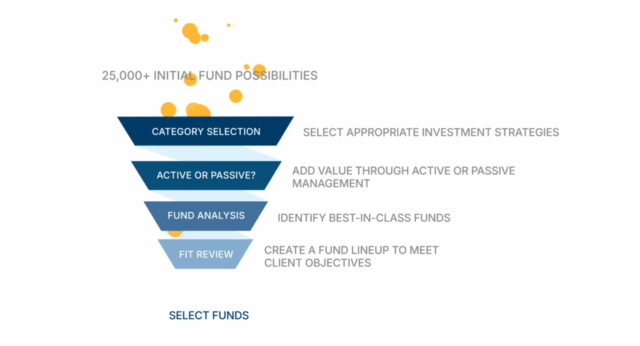
Fisher\SMB analyzes more than 25,000 funds to find the best options for our fund lineup and provides rigorous ongoing fund monitoring. This is what client-first thinking and superior fund management can do.

The 5 Most Common 401(k) Investments
Learn the 5 most common 401(k) investments—index funds, target date funds, bonds, stocks, and cash—explained in simple terms to help business owners and employees make smarter retirement choices.
