

How High-Cost Proprietary Funds Hurt Participants
Overview of Proprietary Funds
Proprietary funds are investment options produced by the same financial institution that handles a retirement plan’s recordkeeping or advisory services. They often appear in plan lineups not because they are in the best interests of plan participants, but because they generate more profit for the provider.
While there is nothing inherently wrong with utilizing a proprietary fund, the decision needs to be supported by an objective, prudent process. With more than 25,000 funds available, it’s hard to justify how a provider’s own proprietary options repeatedly surface as the ‘best’ choices for plan participants under this fiduciary standard.

Did you know?
A Council of Economic Advisors White House Report estimates that conflicted advice costs investors ~1% annually.
For a $100,000 portfolio, that’s about $22,000 lost over 20 years! 1
The Problem with Proprietary Funds
When recordkeepers or advisors recommend products that they manage themselves without a prudent process, their guidance can shift from objective advice to conflicted advice—turning the plan menu into revenue generation rather than a lineup built for participants’ best outcomes.
Conflicted advice can lead to high-cost, low-quality proprietary funds dominating the menu, which can result in:
- Lack of Fee Transparency: Plan Sponsors struggling to evaluate true costs because recordkeepers may claim “low” or “no-cost” administration, while actual fees are embedded within complex, opaque fund structures.
- Diluted Fiduciary Focus: “Good enough” replaces a rigorous search for the best available options.
- Sponsor Liability: Plan Sponsors—not providers—remain responsible for prudent selection and monitoring.
- High Costs & Weak Outcomes: Participants may pay more for funds and/or selection options that lag comparable solutions.
Why it Matters
Ultimately, it can set up plan participants to lose twice: high-cost funds often underperform comparable alternatives and can carry above-average cost.
Over time, this erosion can meaningfully impact employees’ ability to retire with confidence. For a $100,000 portfolio, a 1% difference in performance can equate to $22,000 lower earnings over 20 years, including compounding.
The Fisher\SMB Solution
Move to an objective, open-architecture investment lineup managed by fee-only RIA Fisher\SMB who:
- Reviews all available fund options—not just one provider’s products
- Documents a prudent, defensible selection and monitoring process
- Removes conflicts of interest from the fund menu
- Prioritizes participant outcomes over provider economics
This structure can help ensure the lineup is truly built around best in class, not “best for the vendor.”
Fisher\SMB Investment Selection Process
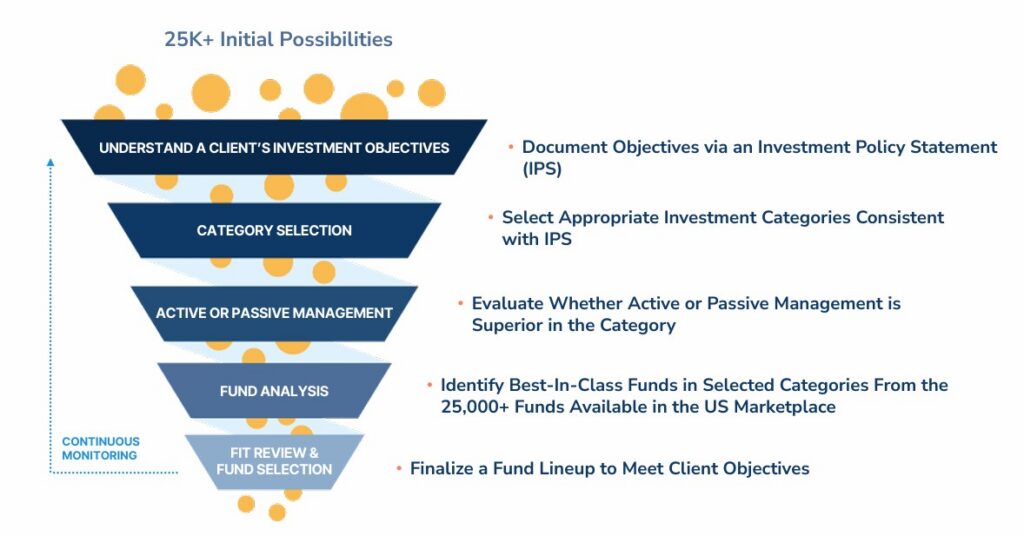
Receive an independent fiduciary review with Fisher\SMB to obtain an objective third-party fund lineup assessment and documentation for your fiduciary audit file.
- 1Assumes 7% annual compound growth over 20 years with a starting balance of $100K.