

403(b) Plans for Non-Profit Organizations
Take the guesswork out of managing your 403(b) plan.
Differences Between a 401(k) and 403(b)
In many ways 403(b) plans are like 401(k) plans.
Both plans provide a tax-deferred vehicle for employees (and employers) to save for retirement. This means that only when it’s time to retire will your employees pay taxes on the money withdrawn. The annual contribution maximums are the same, and both can allow for Roth contributions (in addition to pre-tax contributions).
However, unlike 401(k) plans, 403(b) plans are specifically designed to be offered by non-profit organizations, and as a result have a few rules that make them unique for employers and participants.
Let’s take a closer look at the details of 403(b) plans.

How Are 401(k) and 403(b) Plans Similar?
While there are a few differences between 401(k) and 403(b) plans, these plans are mostly very similar. Both plans provide a tax-deferred vehicle for employees to save for retirement. The annual contribution maximums are the same, and both can allow for Roth contributions (in addition to pre-tax contributions). 401(k) and 403(b) plans both have a 10% penalty if funds are withdrawn prior to age 59 ½.
401(k) vs 403(b) Plan Comparison Chart
Use the chart below to understand the difference in 401(k) plans and 403(b) plans.
|
Category
|
Topic
|
401(k)
|
403(b)
|
|---|---|---|---|
|
General
|
What It Is
|
An employer-sponsored defined contribution plan for business entities
|
An employer-sponsored defined contribution plan for non-profit entities
|
|
General
|
Who Can Sponsor
|
Any business entity. *Non-profit entities have the option of sponsoring a 401(k) or a 403(b)
|
Non-profit organizations, hospitals, schools, churches, 501(c)(3) tax-exempt entities
|
|
Compliance
|
ERISA-Covered
|
Yes
|
Sometimes
|
|
Compliance
|
Form 5500 Required
|
Yes
|
Only if ERISA-covered
|
|
Compliance
|
Nondiscrimination Testing
|
Must pass annual nondiscrimination testing
|
Exempt from certain compliance testing
|
|
Contributions
|
Annual Contribution Limit
|
$23,500 (+$7,500 catch-up contribution for age 50+)
|
$23,500 (+$7,500 catch-up contribution for age 50+)
|
|
Contributions
|
Tax Treatment
|
Contributions are made pre-tax and grow tax-deferred
|
Contributions are made pre-tax and grow tax-deferred
|
|
Investments
|
Investments Allowed
|
Mutual funds, stocks, bonds, annuities, collective funds
|
Only annuities or mutual funds
|
|
Investments
|
Collective Funds–Eligible
|
Yes
|
No (unless a 401(a)/church plan)
|
|
Plan Design
|
Employee Eligibility
|
Can be limited to: Age 21 or over; 1,000 hours of service per year; 12 months of service
|
Employee contributions: No eligibility limits. Employer contributions: Same eligibility limits as 401(k)
|
|
Plan Design
|
Eligible for Maximum Allowable Contribution (MAC Rule)
|
No
|
Yes. Employees who have 15+ years of service with a qualified organization may qualify to contribute an additional $3,000 annually to the plan
|
Which type of retirement plan is best for my non-profit?
Non-profit organizations can choose to sponsor either a 403(b) or a 401(k) plan, but determining which of these plan types is best can be complicated. The best way to determine which of these plans is best for your organization is to seek guidance from an advisor who specializes in retirement plans for non-profit organizations.
Watch Out for “Annuity-Based 403(b) Plans”
If you sponsor a 403(b) plan, you might be familiar with the challenges of annuity-based 403(b) platforms. And if you’re beginning your 403(b) journey, you’ll want to be wary of annuity-based 403(b) platforms. They’re outdated systems—usually written by insurance companies—and could be costing you and your employees big money.
Annuity 403(b) plans can be problematic to your employees in three critical areas: fees, investment quality, and service.

Pro Tip:
Did you know that until recently 403(b) plans were required to be on an annuity platform? That’s why more than half of 403(b) plans are on annuity platforms today. However, there are better solutions available today—like a non-annuity 403(b)
Fees
Fees on annuity platforms are often higher than non-annuity platforms. This is true for 3 main reasons:
- Investments on annuity platforms typically provide commissions to the broker/salesperson, which can inflate the fees.
- Most annuity platforms include insurance wrappers, which add unnecessary expenses to the plan while providing little benefit.
- Many 403(b) annuity platforms are on antiquated platforms that aren’t proactively repriced. Failing to reprice a plan means that even as plan assets grow, you often don’t get a fee break.
This is why it can often be more cost-effective to choose a non-annuity platform for your 403(b) plan.
Investment Quality
Annuity platforms often have lower-quality investment options than non-annuity platforms. This is true for 3 main reasons:
- The investments on an annuity platform typically provide commission to the broker. This means the broker is often incentivized to include investments that pad their own pockets, rather than the best investments.
- Annuity platforms almost always require the use of proprietary funds, which typically provide revenue sharing to the recordkeeper. This revenue sharing can erode performance.
- Annuity platforms typically have very limited investment options, and rarely offer open-architecture investment platforms. This limits options and can reduce availability of high-quality, low-cost investment options.
Service
Non-annuity advisors are much more likely to offer services to set plan participants up for a comfortable retirement.
For example, a specialized advisor may act as a fiduciary for your 403(b) plan. This means they will act in your best interest, not their own.
A non-annuity advisor may be more likely to have the expertise and resources to offer robust participant services. This could include things like meeting one-on-one with employees to discuss retirement goals, as well as providing education around the appropriate savings rate and asset allocation to help them achieve their goals.
This education and support results in employees who are better equipped to achieve their retirement goals.
A Better 403(b) Solution for Non-Profits
While annuity platforms can be problematic, there is a better solution—a non-annuity platform.
A non-annuity platform can allow the 403(b) plan to operate in an environment free of revenue sharing and commissions, and is much more likely to include a specialized advisor who can act as a fiduciary on behalf of the plan. Non-annuity 403(b) plans offer participants substantial benefits in three critical areas: fees, investment quality, and service.
Changing to a non-annuity platform can have a big impact on employee outcomes. The illustration below compares the difference between a 403(b) annuity platform and a non-annuity 403(b) platform. By switching to a non-annuity 403(b) the plan may be able to improve plan fees, investments, and employee contributions which can have a combined impact of ~1% on a plan’s annual performance. That gives each employee an extra $227,000 in retirement savings.
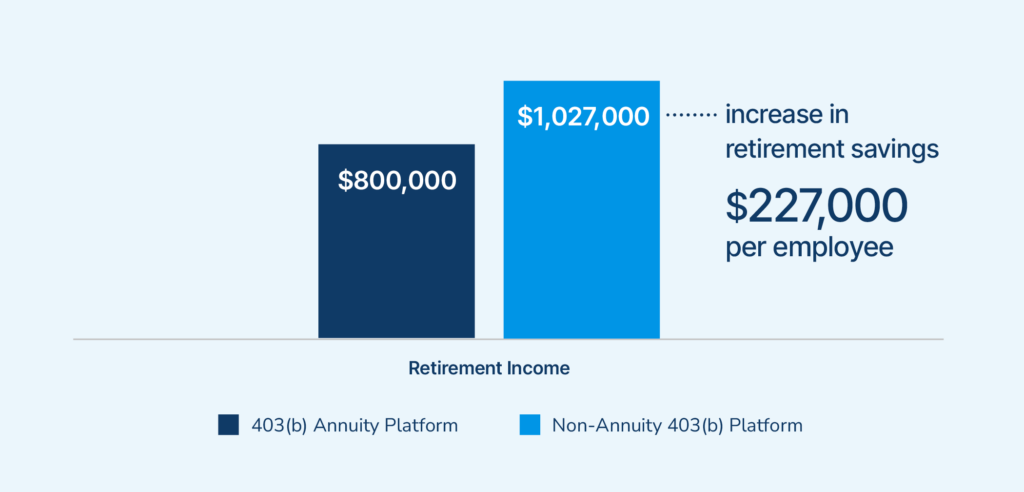
Assumes starting salary of $40,000, which grows annually by 3% over 40 years starting at age 25. Withdrawals begin at age 66 and are equal to 45% of the projected salary at retirement. The lower return portfolio growth assumes 5.5% annual return in the working years and 3.5% return in retirement, while the 1% higher return portfolio growth assumes 6.5% and 4.5%, respectively.
Help give your employees the retirement they deserve with a non-annuity 403(b) plan.
A non-annuity 403(b) plan can offer plan sponsors and participants lower fees, higher-quality investments, and better services than an annuity-based plan. These improvements can lead to employees who are more prepared to afford a comfortable retirement.
You can download a PDF of this guide here.
Give us fifteen minutes and we’ll show how you can help your employees dramatically increase retirement savings.
Learn More about
Non-Profit Retirement Plans

401(k) vs 403(b) Plan Comparisons
401(k) and 403(b) plans both help employees save for retirement, but differ in eligibility, compliance, and investment options. Read this article to learn more.

Why Businesses Trust Fisher\SMB
Discover how our commitment to client satisfaction drives real results. See what our clients are saying.

Fiduciary Retirement Plan Advisors for Government Employers
Fisher\SMB specializes in helping governmental plan sponsors modernize and optimize their public sector retirement plans. Visit the webpage to learn more.