

From the AI Explosion to Cryptocurrency: What to Make of Investing Hype
Time to read 5 Minutes
Betting on the “next big thing” may seem like a shortcut to huge investment gains, but making steady contributions to a diversified portfolio is a much safer way to achieve your retirement goals.
If there’s one thing everybody’s talking about these days, it’s artificial intelligence. Like it or not, AI is showing up in every aspect of society, from careers and entertainment to investments and, in turn, your retirement account. While nobody knows exactly what to expect in the coming years, the frenzy surrounding all things AI has pushed the market to record highs and likely given your nest egg a nice boost in 2026. An eager investor might ask: is now the time to bet big on AI tech stocks?
Let’s discuss why that’s generally not a great idea.
‘Chasing Heat’ Rarely Works
It’s not that AI is overhyped. There is widespread agreement that it’s a transformative technology with the potential to reshape our lives in unimaginable ways. That’s why major technology companies like Alphabet, Amazon, Meta, and Microsoft are spending hundreds of billions of dollars on AI development and infrastructure, fueling growth in supporting industries as well. As a result, AI enthusiasm has been a powerful driver of stock market performance in 2025-2026, with some companies posting stellar gains.
So, what’s the problem with investing in what’s hot? There’s nothing wrong with technology stocks representing a sensible portion of your portfolio. In fact, you probably already own some AI-related stocks through the funds in your retirement plan. But problems can arise when you start diverting money from other investments to aggressively buy up recent winners. Industry professionals call this “performance-chasing” or “chasing heat,” and it can undermine your investing success for two key reasons:
- You’re attempting to time the market. By making heavy investments in technology stocks, you’re betting their impressive run will continue indefinitely. But as you’ve probably read before: past performance is not an indicator of future returns. AI is far from a well-kept secret. At this point, expectations for future growth may already be reflected in stock prices, and there’s no guarantee that they will keep rising rapidly—or at all.
- You’re creating “concentration risk.” When you devote an outsized portion of your portfolio to one industry trend, the consequences of being wrong become greater. If market expectations fall short and stock prices drop; it could result in lasting setbacks to your retirement goals.
Remember the Dot-Coms
The investing world’s obsession with AI may remind you of another technology-driven boom. In the late 1990s, the early days of the World Wide Web, investors embraced the exciting future of the online world, rightfully seeing it as a game-changing development. Money poured into internet-related companies, including hundreds of promising startups, driving tech stocks to extraordinary highs. From 1995-2000, the tech-heavy Nasdaq Composite rose an unprecedented 600%. Famously, the networking company Qualcomm saw its stock rise 2,587% in 1999 alone!
Critics called it “irrational exuberance” and predicted that stock prices were artificially inflated—a “bubble” ready to burst. They were right, and in 2000 the market collapsed. The Nasdaq fell about 78% over the next two years. High-profile startups like Pets.com and Webvan, among others, went bankrupt; Amazon stock dropped 90% and Cisco Systems lost 80%. As the fallout spread, even well-diversified retirement plans took significant losses, but those with a high technology concentration were decimated.
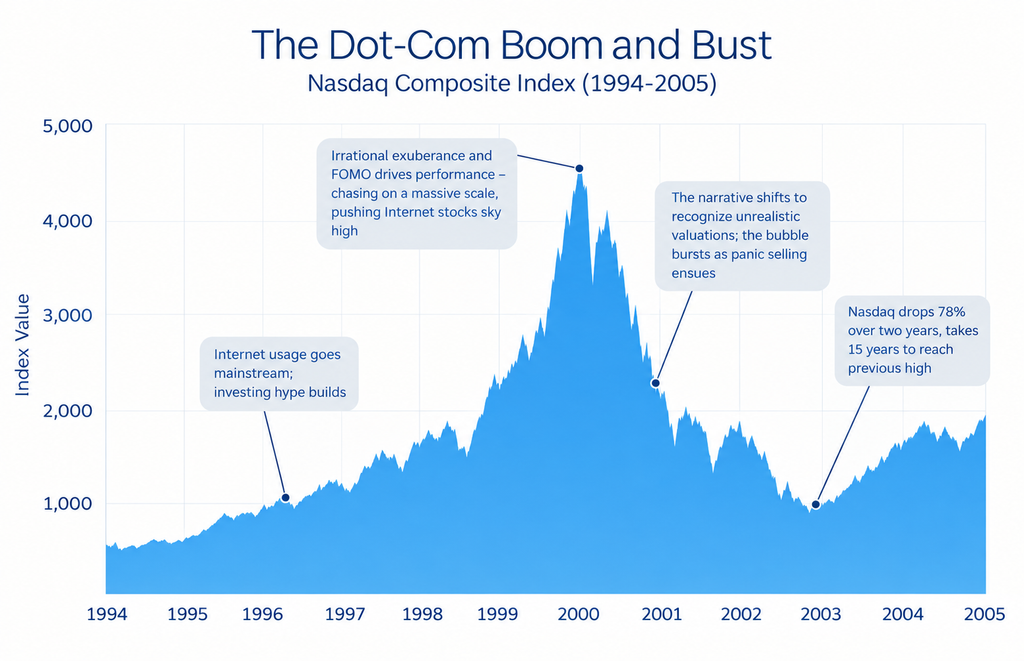
1 Nasdaq chart: Fisher\SMB-created infographic overlaid on publicly available stock market data.
While today’s AI leaders are generally more established and profitable than many dot-com companies were, some observers have nonetheless raised concerns about excessive optimism.
Investing trends outside the technology sector have also inspired performance-chasing in recent years. Gold, silver, and certain cryptocurrencies such as Bitcoin have all had periods of strong returns, largely because they tend to rise when investors seek protection against geopolitical tensions and a weakening currency. But markets can shift quickly.
Regardless of the day’s hot topic, the lesson for long-term investors is the same: staking your future on any particular type of investment—even when the hype is justified—is a risky proposition.
Check Your Emotions at the Door
So why do investors continue to make this mistake? Studies in behavioral finance2 suggest that, too often, people let emotions drive their investment decisions. As a market sector gathers steam, they move from optimism to euphoria, buying when prices are already high and convincing themselves that recent gains will continue. Ironically, this is when risk is highest.
When the market drops, fear and anxiety often lead these investors to sell at exactly the wrong time, robbing themselves of the opportunity to recoup their losses and buy more shares “on sale.” It’s the opposite of what’s most effective for long-term growth.
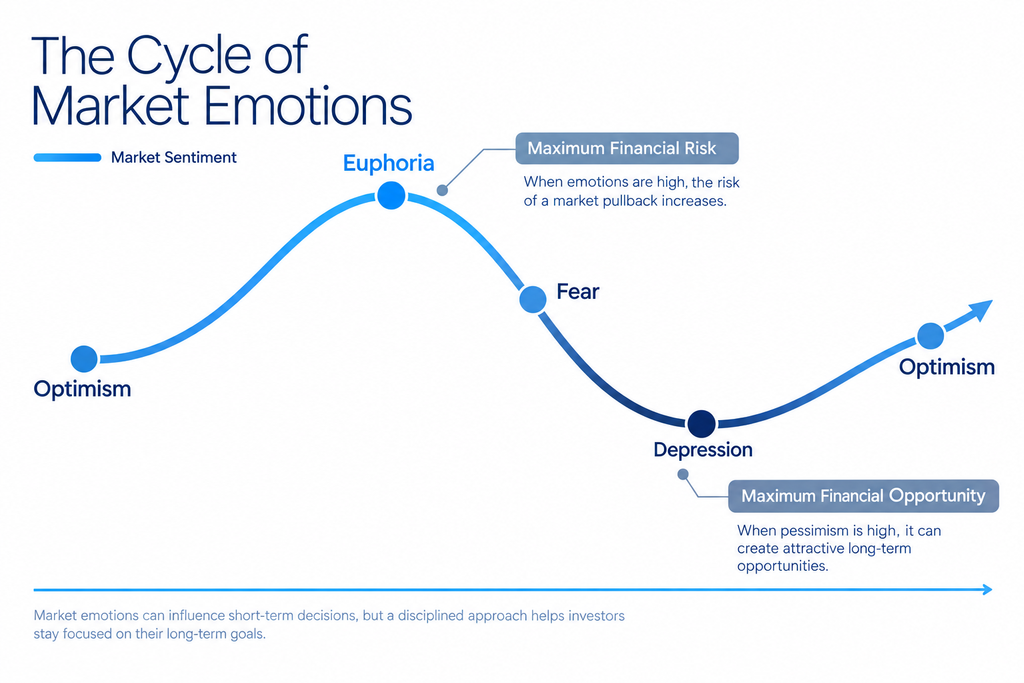
2 Cycle of Market Emotions: Fisher\SMB-created infographic based on the widely used “Cycle of Market Emotions” framework that has been adapted by numerous investment firms, advisors, and financial educators.
A Better Strategy for Long-Term Success
It’s okay to keep an eye on current events, but don’t allow the headlines to derail your investing strategy. History shows that the most reliable way to accumulate wealth over time involves three key behaviors:
- Diversification: Spreading your investment dollars across a wide range of companies, industries, geographies, and asset classes (e.g., stocks and bonds) is still the best way to take advantage of the market’s overall growth over many years. You may not achieve massive gains all at once, but you’ll be better insulated from steep declines in a particular market sector or asset class.
- Regular savings: By making systematic contributions to your account every month, you’re automatically buying more shares when prices are low, and less when prices are high. Known as “dollar cost averaging,” this process takes emotion out of the equation and helps your money grow faster.
- A long-term mindset: The longer you stay invested in the market, the more likely you’ll be able to take advantage of compound growth and see your account balance build on itself. A patient, goals-focused approach reduces the need to gamble on risky get-rich-quick tactics.
Need More Guidance?
With Fisher\SMB as your company’s retirement plan advisor, a helpful retirement specialist is always just a call away. Schedule a meeting any time to review your investments and make adjustments to match your specific situation and retirement goals.